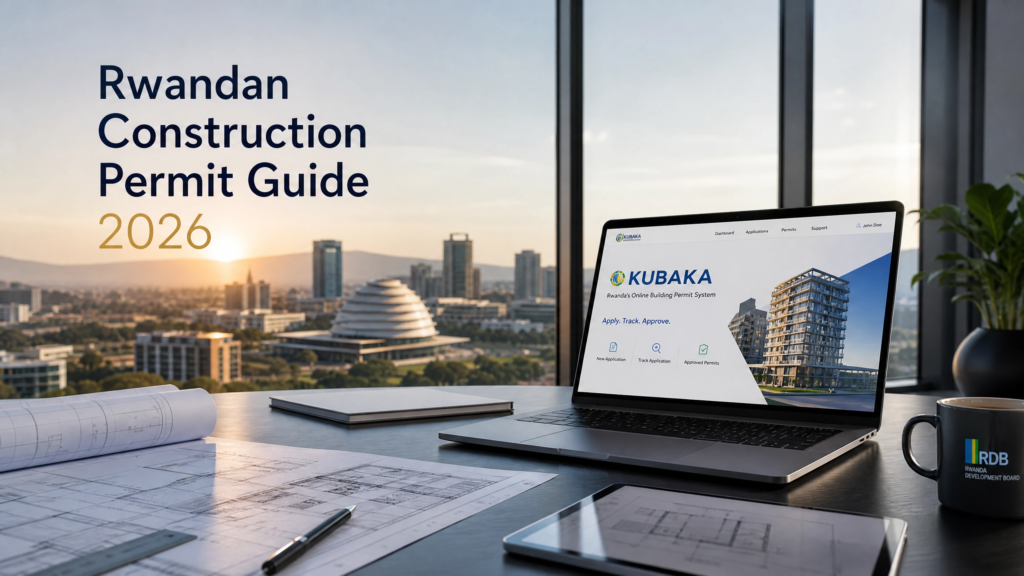
Most foreign investors get Rwanda’s permitting system wrong before they even open the application. Rwanda has built one of Africa’s fastest-digitizing construction economies, backed by a government determined to make Kigali a regional hub for capital and talent. However, the single most common reason projects stall isn’t corruption, cost, or bureaucracy it’s outdated information. This guide provides a complete 2026 update on the construction permit Rwanda process, covering everything from the KUBAKA application to architectural design rules.
The Problem: Why the Rwandan Construction Permit Trips Up Smart People
Rwanda consistently ranks among the easiest places to do business in Africa. The government has spent the better part of a decade digitizing land registration, tax compliance, and construction approvals into a single, interconnected system. That reputation creates a trap. Entrepreneurs and foreign developers arrive expecting a frictionless process and then discover that the system changed significantly in 2025. The old platform, BPMIS, has been replaced by a more advanced system called KUBAKA. Building permit services were also recently added directly to IremboGov, the national citizen-services portal. The Agitation: What Getting It Wrong Actually Costs You
Construction delays in Rwanda rarely come from government inefficiency. They come from applicants who misjudge the process before they ever submit. A common pattern is when a developer assumes their project falls into a lower-risk building category, only to have it flagged during review. The result: the architectural design Rwanda submitted doesn’t meet the technical depth required for that category, and the entire application is returned for revision. That single misstep can cost weeks, translating directly into idle capital.
The Solution: How Rwanda’s Construction Permitting System Actually Works
The Rwanda Housing Authority (RHA) sets the rules, but review happens locally through the City of Kigali or your District One Stop Center (OSC). You can now submit your application through two digital front doors: KUBAKA (kubaka.gov.rw) or IremboGov (irembo.gov.rw). Both routes feed into a “zero trip” process that automatically verifies your identity (NIDA), land tax status (RRA), and professional licensing (IER and RIA). A single unpaid tax bill or an unlicensed architect can stall your application before a human reviewer even sees it.
Building Categories: The Decision That Shapes Everything
Rwanda classifies construction projects by size, occupancy, and risk. Your category determines whether you need an architect, an engineer, or both — and how detailed your submitted architectural design Rwanda must be. Confirm your category with KUBAKA or your local One Stop Center before commissioning final designs.
•Low-risk structures: These modest projects require simpler documentation and shorter review times.
•Mid-sized buildings: Require a registered architect, detailed structural plans, and more comprehensive review.
•Large/Public buildings: Towers, hotels, and hospitals require both a registered architect and engineer, plus documentation on fire safety and environmental impact.
The Process: Eight Steps to a Rwandan Construction Permit
1.Confirm your building category: Verify your project’s risk level directly through KUBAKA or your District OSC.
2.Secure land documentation: Ensure title deeds are current and all land taxes are fully paid to the RRA.
3.Commission compliant architectural designs: Ensure your plans include site layouts, floor plans, and structural engineering as required.
4.Engage registered professionals: Only architects (RIA) and engineers (IER) licensed in Rwanda can submit on your behalf.
5.Submit via KUBAKA or IremboGov: Register your account and upload your full application package.
6.Application review: Monitor progress through real-time SMS and email notifications from the OSC.
7.Pay generated fees: Use the IremboPay gateway for mobile money, bank transfer, or card payments.
8.Download your permit: Construction can legally begin only once this digital document is issued.
Common Pitfalls That Delay Approval
Across most delayed applications, three issues repeat:
•Using unlicensed professionals: If your architect or engineer isn’t registered with IER or RIA, the application cannot proceed.
•Outdated tax records: The system’s automated check will block any application with outstanding land taxes.
•Designing before classifying: Confirming your building category first is the most cost-effective way to avoid design revisions.
Beyond the Permit: The Finish Line Is the Occupancy Permit
Receiving your construction permit is just the beginning. Throughout construction, your project will be subject to scheduled and random site inspections. Any deviation from approved plans requires a formal Construction Project Modification. Once complete, you must apply for an Occupancy Permit. Without this, there is no legal occupation allowed, regardless of how complete the structure looks.